Showing posts with label Social Graces 101. Show all posts

Sunday, August 21, 2022

Finessing the Scone

In the oh-so proper world of tea etiquette there are rules to be followed at tea--from the way you sit to the way you hold your teacup.  You really must mind your t’s and q’s at tea!

Scones are a quintessential part of a Cream Tea.  The scone is a simple biscuit often made plain or with currants and is a perfect accompaniment to a cup of tea.  Whether you pronounce it scone rhyming with bone or scone rhyming with gone, finessing the scone at tea can be very tricky.

I studied etiquette at The Protocol School of Washington with the etiquette expert Dorothea Johnson.  Ms. Johnson has authored several books on the subject of Tea Etiquette and the following methods of finessing the scone are from her books:

~Using the tea spreader/butter knife, slice through the scone horizontally, resting it flat on your plate.  Spoon small dallops (just enough for a single scone) of jam and cream onto your plate.  Never spoon directly onto the scone.  Take only the amount of topping needed to eat that one scone and spread one bit at a time, not over the whole scone.  Use your knife to dab the edge of the scone with jam, then cream; eat that portion and return the rest to your plate.  Between bites, remember to rest the knife on the upper right side of your plate, with the cutting edge of the blade facing the center of the plate.

~Slice through the scone on your plate; lift off the top piece.  Using the spreader, spread only the bottom half first with jam and then cream.  Place the spreader on the upper right side of your plate.  You may pick this half of the scone up with your hand, but be ready to use your serviette for any jam and cream around the mouth area. (This is the way I prefer to eat my scone).

~Slice through the scone on your plate; lift off the top piece, and break off a bite-size piece with your fingers.  Repeat the procedure for adding jam and cream above.

Well-made scones can be pulled apart with the fingers; however, if the scone is not moist, then a spreader/knife can be used.  The English consider it a faux pas to slice the scone with a knife, maybe that’s because their scones are not hard like some we have in the U.S.

Scone Faux Pas:
Unless you are the Queen Of England, remove your gloves at tea.


~Never put the scone halves back together like a sandwich, after spreading on the jam and cream.


~Don’t pour whipped cream over an unopened scone--like gravy over a biscuit.

~Don’t serve the cream and jam from the container directly onto the scone--spoon it onto the tea plate first, the spread a small amount of each onto the scone.

So, which way do you do it?


What is the difference between a Devon and Cornish Cream Tea?  It is the order in which you add the jam and cream onto your scone.  Should you add the jam or cream first?  The Devonshire method is to split the scone in two, cover each half with clotted cream, then add strawberry jam on top.  With the Cornish method, the jam goes on first and then the cream on top.

The Queen reportedly prefers jam first, according to Darren McGrady, a former chef who worked for the royal family from 1982-1993. "The Queen always had homemade Balmoral jam first, with clotted cream on top at Buckingham Palace garden parties in the royal tea tent & and all royal tea parties."

It really doesn’t matter if you add cream or jam first, it’s just a personal preference.

Thank you for visiting with me today!  I will be back tomorrow with a few recipes for a Cream Tea.

Friday, October 26, 2018

Social Calling Cards


Do you have your own social calling cards? I have had calling cards in my stationery wardrobe since I was a young girl.  They are great to use at parties, class reunions, or just to give to an old friend when meeting after a long absence.  The card is a great way to connect socially--"Call me, here’s my number."
If you want to learn more about calling cards, try to find this sweet book "Calling Cards," from Victoria Magazine that I have had in my library for many years. All the publications from Victoria are exquisite and this book is no exception.  It’s full of photos of lovely cards and fascinating facts on the history of calling cards as graceful social accessories.
My cards are engraved in brown on ecru paper.  I have used the same cards from William Arthur for many years--they have my full name and my telephone number in the bottom right-hand corner.  You can find beautiful calling cards online at Crane Stationery.

I will share the rest of my stationery wardrobe in my next blogpost.  Thank you for visiting with me today.

Thursday, October 4, 2018

Lemon Etiquette at Teatime

Lemon is a delightful addition to hot tea and of course there is etiquette to be followed at teatime.  Tea pairs exceptionally well with Anne of Green Gables and today I'm sipping a Darjeeling tea from Harney Tea.  Darjeeling is a black tea--"The Queen of Teas," a blend of First Flush and Autumnal teas from the best tea gardens.  I would only add a lemon slice to a black tea.  Be sure to pour the tea in first, then add sugar, then the lemon.  Lemon is offered thinly sliced (never in wedges!).


A lemon fork (with splayed tines) should be provided.  The tea pourer or the tea drinker can then put a slice directly into the poured cup of tea.  Should you desire another cup of tea, the pourer will remove the slice of lemon from your cup, place it into the tea slop bowl (shown on the right), and pour your tea.  The tea pourer or you may add a fresh lemon slice.  You may also be offered a fresh cup, depending on availability.  Remember that milk and lemon are never used together in tea.  The citric acid of the lemon causes the milk to curdle


Etiquette tip--These are a few lemon faux pas you do not want to commit at teatime:

~Putting the lemon slice into the cup before pouring the tea.  Tea is always poured in the cup first.
~Placing a lemon slice on the edge of the saucer in anticipation of adding it to the cup later.
~Transferring the lemon slice from the cup to the saucer.  You will end up with your cup resting in a puddle of tea.
~Removing the cloves from the lemon slice before placing in the teacup.  The cloves are placed in the lemon slices to add flavor.
~Using the spoon to press the lemon slice after you place it in the cup.  The oil from the peel and the juice from the fruit will provide the desired essence.

"Of course I'll stay to tea, said Anne gaily.  I was dying to be asked."
Anne of Green Gables

Friday, June 29, 2018

Cream Tea at The Queen’s Pantry


Today, I did some shopping in Atlanta and since it is National Cream Tea Day in England (International Cream Tea Day to me), I celebrated at The Queen's Pantry in Marietta. 


Samantha, the owner of The Queen's Pantry, offers Cream Teas on Fridays.  She has three seatings and if you are visiting Atlanta or live in the area, you simply must call for a reservation at 678.483.0900.  They are located at 4235 Merchants Walk Drive, Marietta, Georgia.

This is the menu for the Cream Tea:


The Queen was watching so I made sure to mind my tea's and q's.


The tea sandwiches were served with a side of Branston Pickle, which I love.


The scone was served with clotted cream and strawberry jam, of course.


Perfectly steeped black tea in a dainty teacup.


I was very impressed with the presentation of the check...it arrived on a tea plate and doily, with an after-dinner mint, and a thank-you note from Samantha!  Now I am spoiled and will be disappointed at restaurants in the future when I receive my check without a thank-you note!


Customer service is everything and Samantha went out of her way to make my visit a memorable one.  She deserves my "5 Silver Teaspoons" award!


After tea, I did a bit of shopping.  The Pantry has a wide assortment of tea accoutrements and British foods & party supplies.


Thank you for visiting with me today.  I hope that you have enjoyed the Cream Tea posts this week and that you might have learned something new about Cream Teas!

Tuesday, June 26, 2018

Cream Tea

Tea time is anytime, however, there are certain names for special times of the day to take tea--Breakfast Tea, Elevenses, Afternoon Tea, Light Tea, Royal Tea, Silver Tea, High Tea, and Cream Tea.
Cream Tea is one of my favorites teas!  This British tradition is a light repast that originated in Southwest England. It is served with tea & scones and must include jam and clotted cream.
National Cream Tea Day will be celebrated in Britain this Friday, June 29th.  Since I’m a tea and scone enthusiast, I am enjoying a tea today and will share with y’all the etiquette of a Cream Tea.  Tomorrow I will talk about Finessing the Scone, on Thursday I will offer some Scone/Cream/Jam recipes, and on Friday I’ll post about a visit to a tearoom to enjoy a proper Cream Tea.

I have chosen to enjoy my tea today as a "Low Tea," versus a "Seated Tea," (at the dining table).  A Low Tea is enjoyed while seated in a comfortable chair or seated on a sofa.
I am using a tea table to hold my tea tray.

I will begin by placing my serviette/napkin (12" square) onto my lap.  The serviette is opened fully and placed on the leg area just above the knees.
My tea for today is Harney Tea's ‘Florence’  tea.  It is a chocolate hazelnut black tea.  I love flavored teas!

Since I’m serving myself, I will pour the tea, which was steeped with tea leaves, into my teacup through a silver tea strainer. (The strainer is designed to fit over the teacup to catch tea leaves that escape from the pot when the tea is poured). After the tea is strained, the strainer is placed over a small silver bowl.


What is this??? It’s a Waste Bowl, also known as a Slop Bowl.  It is used for the spent tea leaves (if your tea strainer becomes full) or for emptying the end of a cup gone cold.

The tea plate will rest on the serviette.  The teacup and saucer is held in the palm of the left hand or left on the tea table.  Just remember that the teacup and saucer are never more than 12" apart.
Now I’m off to enjoy my tea this delicious scone.

But, how to add the cream and jam to the scone and how to eat it?  I will be back tomorrow to discuss "Scone Etiquette."  And yes, there are several correct ways to eat a scone!

Wednesday, October 21, 2015

Autumn Soup Tablescape

This past Sunday was the first chilly day we have had this fall season so I knew I wanted to enjoy a bowl of hot soup with the Sunday football.  I'm still on the blue and white dinnerware kick and set the table with that dinnerware and burlap linens.


Candles should not be burned during the daylight hours unless it's a very overcast day or the blinds are drawn.  Okay, so I drew the blinds.

Monogram everything, especially the napkins rings!


I used my Wedgwood "Woodland" soup plates and Johnson Brothers "Blue Willow" dinner plates as underplates.

Social Graces 101 tip:  
There is of course proper etiquette to be followed when eating soup:

At an informal meal you may serve soup in a soup plate on top of an underplate and provide an oval soup spoon.  You will spoon the soup away from you and place the soup spoon on the underplate between sips or when finished.

This is the resting and finished position of the spoon on the underplate at an informal meal.

At a formal dinner, soup must be served in a soup bowl with an underplate and a round/cream soup spoon provided.  Again place the soup spoon on the underplate between sips or when finished.

This is the resting and finished position of the spoon on the underplate at a formal meal.

Mama usually uses seasonal dinnerware for her meals.  On Sunday I changed things up a bit for her and used cute blue and white paper products from Target.

So, remember to practice proper soup etiquette:

Hold the spoon just like a pencil between your index and middle fingers with the thumb up.  Spoon the soup away from you toward the center of the bowl.  Don't fill the soup spoon completely full.  Place the soup spoon on the plate in the 10:20 "I am finished" position in between sips and when you have finished.  Never leave a soup spoon in a soup bowl.  Also, do not blow on your soup to cool it down and do not slurp your soup.

Enjoy the soup season!

Tuesday, August 18, 2015

Little Book of Etiquette


This book, by etiquette and protocol maven Dorothea Johnson, is a handy reference for those who need to brush up on their dining etiquette.  The pocket-size book will show you how to "Eat at ease as a guest or as a host in business and social arenas worldwide."

There is a lot of information packed into this tiny book (it's 3" x 3"), covering:

Dining Dos and Don'ts
Table Talk
American and Continental Styles of Eating
The Dining Tutorial
Eating Various Foods
Finessing the Business Meal
Forms of Service

This book is available on Amazon and would make a great gift for new college students, those entering the business world, or a gift to young people.

Good table manners are the ultimate symbol of who you are and how you were raised.

Monday, March 16, 2015

Royals Coming to America


The Royals are coming y'all!


Prince Charles and Duchess Camilla are coming to America!  On March 17th, they will arrive and spend three days undertaking a broad range of engagements in Washington, D.C. and Louisville, KY.  


Just in case you run into them, you must make sure that you follow proper Royal Etiquette.


Do you curtsy, bow, salute, or shake hands?  Unless you are British, you don't curtsy or bow to British Royalty.  Wait until they speak to you before you speak.  Don't shake hands until the royal hand is offered to you.  


When meeting the Prince, it's a gracious gesture to give a bow from the head.  Address the Prince as "Your Royal Highness," then "Sir."


When meeting the Duchess you might do a little bob, just to show respect.  Address the Duchess as "Your Royal Highness," then "Ma'am."


If you are British, you curtsy to the Duchess...Put your right foot behind your left foot and briefly lower yourself several inches while bending at the knees with one foot forward.  Be sure to keep your upper body straight.


Sarah Brown, wife of the former U.K. Prime Minister Gordon Brown, gracefully curtsies to the Duchess of Cornwall.

Hugging or kissing a member of the Royal Family is definitely a Royal Etiquette faux pas!

Sunday, March 8, 2015

Social Graces Sunday--Remembering Names

Goodness gracious, have you ever forgotten the name of someone you were just introduced to?  How embarrassing is that?!  How does it feel when someone forgets your name?  Not good, right?  Usually you forget someone's name because you are not listening or paying attention.  It happens to all of us...You meet someone during a social function and the next day you see that person again and draw a blank on their name.  Faces are easy to remember, but names, not so easy.

Having just moved to a new town, I meet new people every day.  I'll admit that it's not easy to remember all the names of the new acquaintances I've met at church, at shops, neighbors, et cetera.  

Remembering a person's name is being polite and considerate.  It's the most basic step in showing respect and building a meaningful relationship.  There is no sound as sweet as the sound of one's own name.  You have to make an active effort to focus on the person's name to remember someone's name.  

When you are introduced to someone, repeat their name.  "It's nice to meet you Mary."  Use the person's name frequently in conversation and when saying goodbye.

Find something about Mary and associate that as a visual with her name; i.e., a similar person, place, or thing that you will remember later.  You might also ask for the person's card and make a note later on the card to help you remember the face to the card.

When people wear name badges in public gatherings, it makes things a lot easier!  Name badges should be worn on your right shoulder.  The reason is when we extend our right hand {always the right hand} for a hand shake, our eye automatically goes in the direction of the person's right hand and their right shoulder.  


Everyone struggles with remembering names from time to time.  If you forget someone's name say "Please tell me your name again."

Sunday, March 1, 2015

Social Graces Sunday

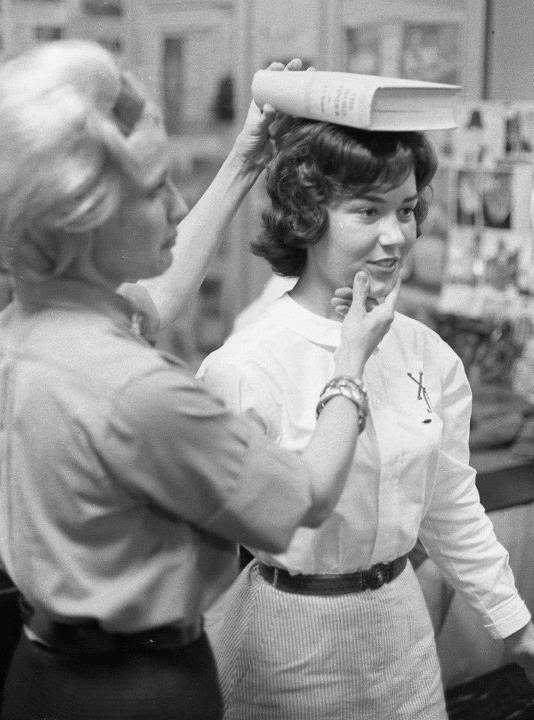
Your posture says so much about you!  The perfect outfit, immaculate makeup, and beautiful hairdo will not camouflage poor posture.  I remember as a little girl walking around inside my home with a book on my head to improve my posture.  Did y'all do this?


The way you stand and they way you sit can make you seem more confident and attractive.  Perfect posture not only keeps you looking youthful, it also helps to alleviate headaches, back pain, and neck pain.  Standing up straight increases your height and is the fastest diet trick ever...you will instantly appear to lose 10 pounds!

Do you have good posture?  Have someone take your full length photo from the front and the side.  Your head and neck should be centered above your torso.  Your chin should be parallel to the floor.  Your back should be straight.  Your shoulders should be pulled back, down, and relaxed with your core muscles pulled in.  Tuck your buttocks under and keep your knees relaxed and your feet forward.


This chart illustrates perfect posture on the top and types of poor posture on the bottom.


The manicurist on the left is displaying poor posture and the right illustration shows her spine aligned correctly.

It's is so easy to slouch, right?  I am constantly correcting my posture and I assure y'all that it is more difficult to maintain proper posture as you age.  I hope y'all won't follow the look of the "Runway Model Slouch" of today or the "Debutante Slouch" which was in fashion years ago!  The rounded shoulders and relaxed stomach is tres chic with some, but over time, poor posture will take a toll on your shoulders, spine, hips, and knees.


So how can you improve your posture?

  • Balance a book on your head and practice walking.

  • Stand as if a string were pulling you up from the top of your head.

  • Sit up straight and don't work humped over at your desk.

  • Consult a personal trainer who can assist you with exercises to strengthen your spine and build core strength.


So start practicing to improve your posture.  Sit up straight.  Stand up straight.  Smile and project an image of confidence!


Sunday, February 22, 2015

Azalea Trail Maids

I have just now gotten around to reading this fun book, "Never Sit Down in a Hoop Skirt," by Crickett Rumley...Hoop skirts, magnolias, and etiquette!

The book is based on the Azalea Trail Maids...Southern Belles who represent the city of Mobile, Alabama.  The author spent her high school years in Mobile, but was never an Azalea Trail Maid herself; however, her friends were.  She journeyed back to Mobile and interviewed present day and former Trail Maids for her book.

The book features seventeen-year-old Jane Fontaine Ventouras, who is returning to her Southern roots in the small town of Bienville, Alabama, where ladies always wear pearls, sip sweet tea, and serve pimiento cheese sandwiches.  Jane is an anti-belle, Goth-girl and her Grandmother got her into the "Magnolia Maid brigade."   The book chronicles her reluctance to become a Magnolia Maid and follow the tradition set out by her deceased mother. 
Crickett Rumley autographs her book .

Azalea Trail Maids wear prissy hoop gowns with frilly hats, monogrammed gauntlets, and parasols.  The Trail Maids are the city's symbol of hospitality.  They greet visitors at the Mobile airport and conventions and also travel around the country representing Mobile.


The Trail Maids at the Macy's Day Parade.

The frilly pantaloons worn under the dresses.

How are Azalea Trail Maids chosen?

Each year, hundreds of high school juniors in Mobile County, Alabama, try out for the opportunity to represent the city as a Trail Maid. Each high school has the first level of competition, from which 100 candidates are chosen to try out at countywide interviews. Ultimately, 50 girls are chosen to represent the city of Mobile, Alabama, as ambassadors. The program is overseen by the Jaycees organization.

What happens once the selection is made?

Once the Maids are chosen, the next step is to create each girl's costume. The colors are baby maize, petal peach, baby blue, light orchid, light aqua and the queen wears a baby pink dress. During the application process, each girl submits her three top dress color choices to the Jaycees, who ultimately make the decision about which color each Maid wears.
Each girl secures a dressmaker to construct her attire. Since there are 50 Maids, 10 girls will wear each of the five colors. One of the girls is named Azalea Trail Queen at a reception in early December, and her dress will be pink. A few days after the queen is announced, the fabric will be distributed and the dressmaking process begins.

About Azalea Trail Maids Dresses

I found this interview with Susan Finizola, a professional dressmaker who has created a number of the costumes:

What are the distinguishing characteristics of the Azalea Trail costumes?

These dresses are a representation of antebellum style but are not intended to be authentic. They are sewn from polyester fabric and poly/satin ribbon. Many people say the Maids conjure up an image of a Southern garden party in the spring 100 years ago.
There are specific guidelines for the dresses. For example, the bottom edge of the finished dress must be four inches off the floor. Additionally, ruffles on the edge of the hat, the edge of the parasol and the ruffle around the shoulders are mandatory. Monogramming is limited to certain spots, while embroidery embellishments may be on most areas of the attire.

How much fabric and lace is used to make the costumes?

ruffled azalea trail dress
The base supplies the Jaycees order for the construction of each outfit consists of dress fabric, steel for the hoop, fur, a wire frame for the hat, a parasol frame and a dress bag. Dress fabric includes 75 yards of organza and 15 yards of taffeta dyed specifically for the Mobile Azalea Trail. The fabric is dyed in Japan and distributed through Berenstein Textiles of New York. When the Maids are dressed the only visible fabric on the dress, hat, parasol and gauntlets is the organza and taffeta.  Ten yards of cotton broadcloth is used for the hoop. The cape is lined with one and a half yards of fur. The Pantaloon fabric is where the personality of each Maid shines. This fabric is purchased by each Maid here in Mobile or by mail order.
In addition to the over 100 yards of fabric that goes into each costume, the dressmaker uses thousands of yards of thread and between 300 and 1,500 yards of ribbon. I also use at least 400 yards of fishing line in the edge of the ruffles. Other supplies include hooks and eyes, zippers, buttons, elastic, interfacing, and many other sewing notions.
Some Maids request lace on their dresses. Usually the amount of lace is about half the amount of ribbon used on the same style of dress.

What do the dresses cost?

Some dressmakers make traditional dresses only, while others are known for being avant garde. In my experience, the complete attire the Maid wears can cost between $3,000 and $6,000. On rare occasions a Maid's relative will construct the attire for free or at a lower price. This can decrease the price to as low as $1,500.

How did you get started making Azalea Trail costumes?

I was involved with the Azalea Trail Organization from 1995 to 1999. In 1999, at the encouragement of a good friend, I began making Azalea Trail dresses. It was a natural progression since I have been sewing and designing for the past 35 years. I also make many other types of dresses and costumes, including Mardi Gras dresses and christening gowns.

What do you enjoy the most about making these dresses?

Azalea Trail Dress Detailing
For me, the creativity is the most enjoyable part of making these dresses. I can make a beautiful traditional Azalea Trail dress and have done so in the past. However, I prefer the avant garde style of Trail Dress. I was one of the first (if not the first) to use covered buttons on the costume. Each girl decides independently on her theme. If a Trail Maid has an unconventional idea I will work with her to incorporate it into the dress in a tasteful way. This year two of the five dresses I constructed have seashell motifs. There were other dressmakers who would not let their girls use seashells, but not me.
Each Maid gets so excited about her dress, and that is the second most enjoyable aspect of making these dresses.

I adore these dresses and the entire costume and have worn similar (but not near as fancy) gowns when I was a teenager.  So how in the world does one get around and sit down in a hoop skirt?  The hoops are usually flexible and you can press them to pass through a doorway.  Sitting down on an armchair is not going to happen though. You need to sit on chair without armrests and sit on the edge of the seat, lifting up the back a few inches before being seated.